
Campbell Voter Lookup Route
For a Campbell resident checking a personal record, the main official tool is California Secretary of State My Voter Status. It is meant for the voter whose record is being checked. It is not a public people-search index, and it does not let a user browse all registered voters in Campbell by name. The state describes the lookup as a way to confirm registration status, political party preference, language preference, vote-by-mail or provisional ballot status, polling place details, vote centers, ballot drop-off locations, voter information guide details, county election contact information, and districts.
Use the state lookup first when the goal is to verify your own Campbell voter registration. If the tool does not answer the question, use the Santa Clara County Registrar of Voters page for county registration channels. The county page points residents to online registration, mail, and in-person options. For district context tied to a local address, the county also provides an address-based district lookup.
| Lookup item | Input type | Required? | Campbell voter notes |
|---|---|---|---|
| My Voter Status identity fields | App-rendered form | Not fully captured | The research confirmed the tool purpose, but not exact static field labels. |
| Registration status | Lookup result | Returned when matched | Used for the voter's own current status. |
| Party and language preference | Lookup result | Returned when available | California lets the voter check these personal record details. |
| Vote-by-mail or provisional status | Lookup result | Returned when available | Useful after registration, ballot, or provisional voting activity. |
| Polling place, vote centers, districts | Lookup result | Returned when available | County contact and district facts can be shown with the matched record. |
The screenshot source for the official lookup is the California My Voter Status form.
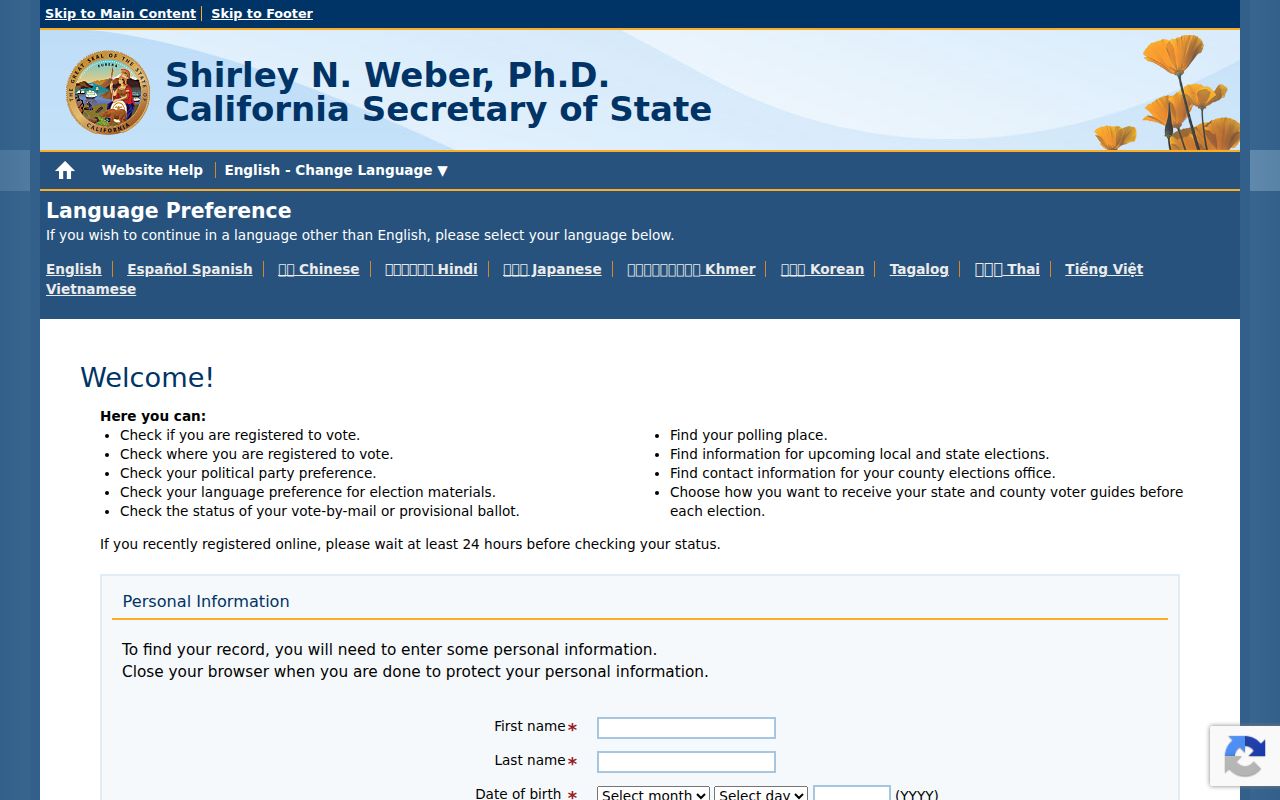
The image supports the main distinction for Campbell voter records: the state gives voters a status-check tool, while bulk voter data uses a separate request process.
Because the My Voter Status interface is app-rendered, the research did not confirm every exact field label visible at runtime. Do not infer hidden fields from older screenshots or third-party summaries. For a voter record that is not yours, the lawful route is a state or county voter-file request, not trial-and-error use of the personal lookup.
Campbell Voter Records Limits
California treats voter data as a law-governed record set. The Secretary of State voter-file application cites Elections Code sections 2188, 2194, and 18109; Government Code section 7924.000; California Code of Regulations sections 19001-19013; and Business and Professions Code section 17538.41. The application states that the information is not public data. That phrase matters. It means voter records may be disclosed through official channels for approved purposes, but they are not the same as an open web directory.
For Campbell, this split keeps casual searching separate from authorized election data work. A person may check their own registration through My Voter Status. A qualified requester may apply for a voter file through Santa Clara County or the Secretary of State. A person who only wants a name-to-address list for private curiosity does not get a free browse-all voter roll.
California confidentiality rule. Driver license numbers, Social Security numbers, signatures, protected voter information, and sensitive identity data are withheld under the voter-file laws cited by the state application, including Elections Code sections 2188, 2194, and 18109.
Campbell Voter Record Fields
Authorized voter-file workflows can contain more than the voter-facing status tool shows on screen. The research for Campbell identifies name, residence address, mailing address when different, party preference where applicable, precinct and district data, registration or status data, and voting participation history as the main categories available under approved file workflows. Ballot choices are never part of the record. A participation history can show whether a voter took part in an election, not how the person voted.
The most useful way to read a voter record is field by field. Some facts identify the voter and the district. Some facts support election administration. Others are suppressed because the law treats them as private, sensitive, or protected. Campbell voters are in Santa Clara County's election system, so county district and precinct facts may matter when matching a local address to the correct election office context.
| Name | Available in an authorized voter file. |
|---|---|
| Residence address | Available unless a confidentiality rule or protected-voter program applies. |
| Mailing address | Available when present and not protected. |
| Party preference | Available in California voter data contexts where applicable. |
| Registration or status data | Available through authorized files; a voter can check personal status through My Voter Status. |
| Precinct and districts | Available through voter data and county address-based district tools. |
| Voting history | Shows participation only, never ballot choices. |
| DL, SSN, signature, sensitive ID | Confidential or withheld. |
Confidential by law. The state application cites Elections Code sections 2188, 2194, and 18109, and it withholds driver license numbers, Social Security numbers, signatures, and protected voter information. Protected address programs can also suppress a residential address.
Campbell Voter File Requests
The Santa Clara County Registrar of Voters is the county channel for Campbell voter and election data. The county's voter data process is separate from the My Voter Status lookup. County materials say applicants must submit an application with a wet signature, meaning an ink-signed original, and fee. The research captured a common county voter data file fee of $176, along with county request instructions and use restrictions.
Use the county route when the requested voter roll is local to Santa Clara County or tied to Campbell precinct and district work. The county's confidential voter-registration-data page is also the point to check because it frames the application, payment, and lawful-use limits. If the county page is temporarily blocked or unavailable, call or contact the Registrar of Voters rather than using a nonofficial data seller.
| Channel | What the request needs | Campbell voter data result |
|---|---|---|
| Santa Clara County Registrar of Voters | Official application, wet signature, fee, and stated lawful use. | County voter or election data for Campbell and other Santa Clara County areas. |
| California Secretary of State | Requester ID, organization if any, jurisdiction, intended use, documentation, original signature, current driver license or state ID copy, and payment. | Statewide, county, district, or specific-voter data, depending on the request. |
| Personal My Voter Status lookup | The voter's own identifying information in the state app. | Personal registration, party, language, ballot, polling place, county contact, and district facts when matched. |
| County district lookup | Address-based district search. | Precinct and district context for a Campbell address, not a voter roll. |
Getting Campbell Voter Data
The statewide route is the California Secretary of State voter registration information file request. The state application says the data can be used only for authorized election, scholarly, journalistic, political, or governmental purposes as defined by law. The requester must identify the requested jurisdiction or data set, explain the intended use, provide documentation, sign the application, include a copy of a current driver license or state ID, and pay the required fee. Campbell records may be part of a county, district, statewide, or specific-voter request depending on scope.
State processing is usually 7 to 14 business days. Statewide, county, and district files are distributed on encrypted DVD as tab-delimited voter, voting-history, and district files. Specific-voter records are delivered by encrypted WinZip email. That delivery format is a sign that California voter rolls are controlled files, not public web results.
- Choose the channel. Use Santa Clara County for county data, or the Secretary of State for statewide, county, district, or specific-voter requests.
- State the authorized purpose. The application must match an approved election, scholarly, journalistic, political, or governmental use.
- Attach identity and purpose material. The state application requires a current driver license or state ID copy, documentation of use, and an original signature.
- Pay the fee and wait for processing. County research captured a common $176 file fee; state cost depends on scope.
- Use the encrypted file as limited. Keep voter, voting-history, and district files within the purpose approved by the custodian.
Campbell District Lookup Context
A voter file often ties a person to precinct and district data. For Campbell addresses, Santa Clara County's Look Up Your District tool is the official county route for address-based district context. It can return precinct and district information. That is different from asking for a voter roll, but it helps explain why an address may connect to a particular ballot, district, or county election contact.
This is also where Campbell's city status matters. Campbell is a city in Santa Clara County, and the county administers the voter data systems used for local records. A district lookup can help confirm the election geography before a formal data request is filed. It can also reduce mismatches when a mailing address, residence address, or nearby jurisdiction creates confusion.
Note: District lookup is address-based context; it is not a name directory for Campbell voters.
Protected Campbell Voter Records
California privacy programs shape what can be found in voter records. Safe at Home is the Secretary of State address confidentiality program. It gives qualified participants a substitute mailing address as part of a safety plan. Research for Campbell notes that protected address programs can suppress residential address disclosure for qualifying voters.
That protection affects both casual assumptions and formal requests. If a Campbell voter is protected, the public-facing or authorized data channel may omit or substitute address information. Do not treat a missing address as proof that a record does not exist. It may mean that the custodian has applied a confidentiality rule.
Campbell Voter Roll Use
California voter-file applications warn against unauthorized and commercial use. The research also notes that the California Public Records Act does not create permission to stalk, harass, impersonate, or evade confidentiality programs. For Campbell voter records, the lawful path is narrow: use personal lookup tools for your own status, and use voter-file data only for the authorized purpose stated in the application.
Misuse can move beyond a records-office problem. Section 14 of the research identifies voter-data misuse as a matter for the Registrar of Voters, Secretary of State, or law enforcement, depending on the conduct. Keep copies secure. Do not republish sensitive voter information, and do not use voter records to contact, pressure, or harm a person.
Use limit. A Campbell voter file request must stay within the authorized purpose approved by the county or state election custodian.
Campbell Historic Voter Sources
The research did not confirm a Campbell-specific run of historical poll books or voter registers from an official archive. That gap should be kept visible rather than filled with a guessed collection. For older Campbell people research, use broader official and library sources: the Santa Clara County Archives, the Campbell Library, and regional local-history collections.
Campbell incorporated in 1952, while Santa Clara County records begin much earlier in California statehood. The Campbell Library's local-history timeline also predates city incorporation, and county or regional records may hold older civic clues. For family history, former-resident research, or heir work, voter records may be only one part of a larger trail that also uses probate, recorded documents, newspapers, and city directories.
Note: No exact Campbell poll-book coverage was verified in the research, so cite the archive or library that actually holds the record before relying on it.
Campbell Voter Records and CPRA
The California Public Records Act, or CPRA, is codified in Government Code division 10. It sets the general request framework for many public records, including a 10-day determination rule in Gov. Code section 7922.535 and prompt access principles in Gov. Code section 7922.530. Voter data does not become open merely because CPRA exists. Election statutes and regulations still control who may receive voter-file information and what must be withheld.
That makes the voter-roll workflow different from a standard city records request in Campbell's GovQA system. If the question is about voter data, start with the Registrar of Voters or Secretary of State. If the question is about city records, police records, permits, or other municipal files, the broader Campbell public-records workflow belongs in the Campbell public records process.